COMSOL Blog

COMSOL Conference 2013 Abstract Submission Guide

Conference | Posted on June 19th, 2013 by

Deadlines always approach faster than expected, and the early bird abstract submission for the COMSOL Conference 2013 is no exception. This is why I have put together a simple abstract submission guide to help you through the submission process. Submitting your abstract by the early bird deadline not only means saving on your registration fee (something your boss and budget are sure to appreciate), but it also gives you the possibility to interact with your Program Chair and the Program Committee at an early stage. Your abstract will benefit from the suggestions and comments from a panel of multiphysics simulation experts. We’ve also changed the paper submission procedure, which I will discuss in more detail here.

Presentation at the COMSOL Conference 2012

Read more on: COMSOL Conference 2013 Abstract Submission Guide

Thermal Analysis Measures Blistering Heat

Heat Transfer | Posted on June 18th, 2013 by

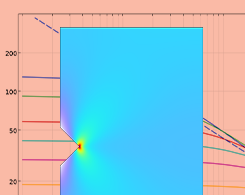
If you roast a turkey for dinner and you need to check the temperature, the technology exists to find it. But what happens if the temperature is so hot that a consumer-grade thermometer, or any man-made device, really, would instantly melt and be destroyed? This might not be a common occurrence in your kitchen, but it is a real concern in blast furnaces, where temperatures can reach close to 1,500°C. Simply guessing is far from safe. Luckily, simulating with COMSOL Multiphysics combined with the Heat Transfer Module you can accurately determine temperatures when measurement tools fall short.

Read more on: Thermal Analysis Measures Blistering Heat

CFD Applied to Two-phase Flow, an Italian Dressing Simulation

Fluid | Posted on June 17th, 2013 by

The fact that oil and water don’t mix is something that you are probably all familiar with. At one point or another, you’ve most likely noticed what happens when you shake a bottle of say, Italian salad dressing, and the liquids mix momentarily, only to become separated again within seconds as oil bubbles rise to the surface. Creating a simulation describing how these two immiscible fluids interact is a great way to introduce computational fluid dynamics (CFD) applied to two-phase flow.

Read more on: CFD Applied to Two-phase Flow, an Italian Dressing Simulation

Modeling a Helicopter Swashplate Mechanism

Mechanical | Posted on June 14th, 2013 by

A swashplate mechanism, used in a helicopter to control the pitch of the rotor blades, can be easily simulated using the Multibody Dynamics Module available in COMSOL Multiphysics. This module enables simulation of an assembly of flexible and rigid bodies, together with physical phenomena from fluid, heat, and electrical applications, among others. Here, we will show you a model to convey how a swashplate mechanism works and at the same time analyze the stresses and deformation in the flexible rotor blades.

Read more on: Modeling a Helicopter Swashplate Mechanism

Combining COMSOL Multiphysics® and MATLAB®

Interfacing | Posted on June 13th, 2013 by

Did you know that you can combine the strengths of COMSOL Multiphysics® and MATLAB® in real time to solve engineering simulations? To me, that sounds like getting the best of both worlds. Let me explain.

Read more on: Combining COMSOL Multiphysics® and MATLAB®

Electrochemistry, from Electroanalysis to Industrial Electrolysis

Chemical | Posted on June 12th, 2013 by

My colleague, Edmund Dickinson, recently blogged about cyclic voltammetry, and how this can be modeled. It was a fantastic blog entry, as it really described the application, and how to implement such models in COMSOL Multiphysics. While Edmund has a background in electroanalysis, where cyclic voltammetry, potentiometry, and electrochemical impedance are important tools, I had a different but similar life before COMSOL, working within industrial electrolysis. For both of us, the new Electrochemistry Module would have been the perfect tool had it been around then, as it would have catered to each of our needs.

Read more on: Electrochemistry, from Electroanalysis to Industrial Electrolysis

Video: 2D Models from Cross Sections of 3D Geometries

Tips & Tricks | Posted on June 11th, 2013 by

A while back, I blogged about a new feature made available in COMSOL Multiphysics 4.3b, the ability to create 2D models from the cross sections of 3D geometries. We are so excited for this new feature that we decided to make a video showing you how easy it is to use.

Read more on: Video: 2D Models from Cross Sections of 3D Geometries

A Recipe for Induction Stove Design Using Multiphysics Simulation

User Perspectives | Posted on June 10th, 2013 by

When I was little, I used to love spending the night at my grandparents’ house, where I was allowed to watch TV, stay up late, and in the morning, help my grandmother make pancakes. The hardest part was always waiting for her old, slow electric burner to heat up — to my six-year-old self, it seemed to take hours for the burner to become hot enough after we’d finished mixing the batter. Luckily for me, and for other impatient chefs out there, there is now a faster, safer option: the induction stove.

Read more on: A Recipe for Induction Stove Design Using Multiphysics Simulation

Food Science Leverages Simulations

Multiphysics | Posted on June 7th, 2013 by

As computer hardware becomes more powerful and affordable, simulations are becoming commonplace in new disciplines of science and engineering. Food science engineering is one such area, and there is no shortfall of publications using COMSOL Multiphysics for food-related simulations. Such kinds of analyses pretty much always require several types of physics to be practically relevant.

Read more on: Food Science Leverages Simulations

Structural Mechanics Tutorials: Rigid Connector and Linear Buckling

Mechanical | Posted on June 6th, 2013 by

Continuing our structural mechanics tutorial blog series, we have created two more videos of different functionality existing in COMSOL’s Structural Mechanics Module. The first post in the series introduced you to the Structural Mechanics Module via a linear elastic analysis of a bracket, and the following post included two supplemental videos for adding Initial Strain and Thermal Stress to the this model. Next up we have two more “mini-tutorials” — this time outlining the Rigid Connector feature and the Linear Buckling study type.

Read more on: Structural Mechanics Tutorials: Rigid Connector and Linear Buckling